
Most Bradford homeowners do not realise how serious a cockroach problem is until it is already well out of hand, for every single cockroach you spot in your Bradford home, there are at least 10 more hiding somewhere you cannot see. That one roach scurrying across your kitchen floor at midnight is never, ever alone.
A lot of Bradford homeowners grab a can of spray from the supermarket, treat the surfaces they can see, and assume the job is done. A few weeks later, the roaches are back and usually in bigger numbers. That is because store-bought products rarely reach the places where cockroaches actually live and breed.
Calling a professional cockroach exterminator is the step that actually makes a difference. But if you have never booked a pest control visit before, you probably have no idea what to expect. Will you need to leave the house? What chemicals are used? How long does the whole thing take?
This guide answers all of that. We are walking you through every single stage of a professional cockroach exterminator visit from the moment the technician rings your doorbell to the final follow-up check, so there are absolutely no surprises.
Why a Cockroach Infestation in Bradford Is a Bigger Problem Than You Think
The Danger You Cannot See Is the Real Problem
Most Bradford homeowners do not take a cockroach infestation seriously until things have already gotten out of hand. By the time roaches are visible during the day, the population hiding inside your walls has almost certainly been building for months.
The thing about cockroaches is that they are nocturnal insects. During the day, they stay tucked away in warm, dark, damp harbourage areas behind kitchen appliances, under sinks, inside wall cavities, around pipe gaps. They only come out after dark to forage for food, which is why so many people are completely blindsided by how bad things have gotten.
And this is not just about the unpleasantness of sharing your home with pests. Cockroaches carry harmful pathogens on the tiny hairs covering their legs and bodies. Every surface they walk across gets contaminated. The health risks are real and well-documented:
- Salmonella and E. coli spread through droppings left on worktops and food prep areas
- Gastroenteritis and Staphylococcus from contaminated dishes, pans, and utensils
- Asthma aggravation, cockroach allergens are a major trigger, particularly for children living in Bradford terraced homes and flats
- Food poisoning and allergic reactions caused by cockroach droppings, shed skin, and even dried saliva left on surfaces
The longer you leave it, the harder cockroach removal becomes. With that in mind, let us get into exactly what a professional visit looks like and why it works where DIY never quite does.
Step-by-Step: What Happens During a Professional Cockroach Exterminator Visit in Bradford
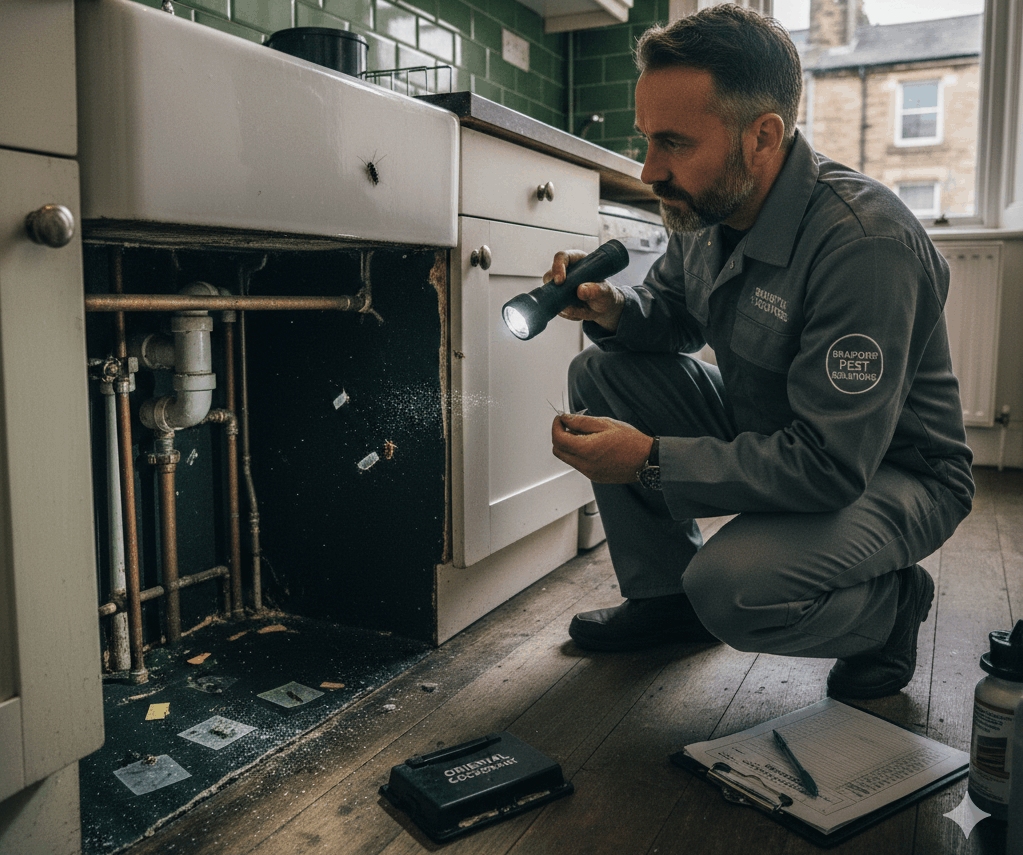
Step 1: The Inspection Comes First, and It Is the Most Important Part
The very first thing a trained technician does when they arrive at your Bradford property is a proper, thorough cockroach inspection. A lot of people expect them to walk straight in with a spray bottle, but that is not how a professional operation works. Treatment without inspection is just guesswork.
Here is what the technician is actually checking for during this stage:
-
- All the key harbourage areas are the warm, damp, dark spots where cockroaches set up home, including behind the fridge, beneath the dishwasher, inside bathroom cabinets, and under kitchen units
-
- Cockroach droppings, these look like tiny, dark specks or coarse coffee grounds and are usually clustered on cabinet hinges, under sinks, and around pipework
-
- Egg capsules, known as ootheca, small, brown, rice-shaped casings that can hold up to 50 eggs each and are often tucked away in sheltered spots near food or water
-
- Entry points, cracks in walls and floors, gaps beneath external doors, openings around waste pipes and drains, where roaches are getting in from outside
-
- The overall severity of the infestation determines how aggressive the treatment plan needs to be
The inspection usually takes somewhere between 20 and 40 minutes, depending on the size of the property. Everything found during this stage directly informs the cockroach treatment plan used in the steps that follow. Think of it as building a proper battle plan before the fight starts.
Step 2: The Technician Explains the Plan Before Anything Else Happens
A trustworthy cockroach exterminator will not start any treatment without sitting down and walking you through exactly what they are going to do and why. After the inspection, you should expect a clear, plain explanation of the approach.
The conversation will usually cover:
-
- Which species were found the German cockroach, American cockroach, and Oriental cockroach are the three most commonly found in Bradford homes and commercial properties
-
- Which treatment methods are being recommended, and the reasoning behind each one
-
- Whether you need to leave the property while treatment is carried out, and for how long
-
- Any steps you need to take beforehand, things like clearing items from under the sink, covering food, and making arrangements for pets
-
- A clear breakdown of the cockroach extermination cost and whether follow-up appointments are included
-
- This is also a good moment to ask whether pet-friendly or eco-friendly cockroach control products are available. Many Bradford pest control companies now offer these as a standard option, and it is worth knowing upfront.
Step 3: The Active Treatment: Three Methods Working Together
Professional cockroach extermination services in Bradford do not rely on a single spray and hope for the best. A proper treatment uses three methods working in combination, with each one targeting a different part of the cockroach population.
-
-
- Residual Spray Treatment
A fine mist of residual insecticide gets applied to the backs and undersides of kitchen appliances, inside and outside of cabinets and drawers, along skirting boards, under counters, and around radiators. It kills cockroaches on contact and keeps on working for up to six months because roaches are exposed to the treated surface every time they move through the area.
-
- Cockroach Gel Bait Treatment
Small drops of cockroach gel bait are placed strategically on cabinet hinges, beneath sinks, and behind appliances. Here is what makes this method particularly effective cockroaches are a cannibalistic species. When one roach feeds on the bait and dies, others in the same colony feed on the dead body and get exposed to the bait that way. The effect spreads deep into the harbourage, reaching cockroaches that a surface spray would never get close to.
-
- Silica Dust Powder Treatment
A fine silica dust insecticide gets injected into wall cavities through electrical sockets, gaps beneath skirting boards, and the spaces around pipes. This creates a protective powder barrier inside the walls that physically damages the cockroach’s outer shell, eventually killing it. In Bradford terraced houses and semi-detached properties with shared walls, this step is especially important because it stops cockroaches from moving between properties through wall cavities.
Step 4: Entry Points Get Sealed and You Get Proper Advice
Once the active treatment is finished, a good cockroach exterminator does not just head off to the next job. They will go around the property identifying and helping to seal the entry points where cockroaches have been getting in, such as gaps around pipework, cracks in external walls, and spaces beneath doors.
Alongside that, you will get honest, practical cockroach prevention guidance that actually makes a difference:
-
- Keep all food in properly sealed containers and make sure nothing is left out overnight food residue left on worktops is one of the main reasons cockroaches keep coming back
-
- Fix any leaking taps or dripping pipes straightaway, cockroaches need moisture and a damp environment gives them exactly what they need to survive
-
- Get into the habit of cleaning behind appliances regularly and vacuuming kitchen floors every day
-
- Put baited glue board traps down after treatment so you can keep an eye on activity between professional visits
-
- Use boric acid in corners and hard-to-reach spots as an extra preventive layer
According to the Centers for Disease Control and Prevention (CDC), keeping kitchens and bathrooms clean and dry consistently is one of the most effective long-term strategies for deterring cockroach activity.
Step 5: The Follow-Up Visit: Where the Job Actually Gets Finished
One treatment session alone is rarely enough to fully clear a serious cockroach infestation, particularly in Bradford terraced rows or flats where cockroaches can move freely between properties through shared walls, floors, and drains.
A proper pest control company will book a follow-up visit roughly two to three weeks after the initial treatment to:
-
- Check the glue board traps and see what the numbers are showing
-
- Apply fresh gel bait in areas where activity is still being picked up
-
- Re-examine previously treated entry points for any signs of new movement
Some Bradford pest control companies also offer a quarterly cockroach prevention programme that covers regular inspections and bait renewals throughout the year. This kind of ongoing approach is the difference between solving the problem once and solving it for good. Always ask upfront whether follow-up visits are part of the package or whether they are charged separately.
Practical Tips for Before and After the Visit
What to Do Before the Technician Arrives
A bit of preparation on your end makes the treatment significantly more effective. Before the technician gets there:
-
- Clear everything from under sinks and inside lower cabinets so the technician has direct access to the main harbourage zones
-
- Pull appliances slightly away from walls if you can manage it safely
-
- Remove or cover pet food and water bowls before treatment begins
-
- Vacuum the kitchen thoroughly to get rid of crumbs, food residue, and loose cockroach droppings
-
- Tie up and seal your rubbish bags so they are not acting as a food source during or after the visit
What to Do After the Technician Leaves
-
- Do not mop or wipe down treated surfaces for at least 48 to 72 hours the residual spray needs time to do its job without being washed away
-
- Avoid using your own sprays or strong cleaning products on treated surfaces, as they can break down the gel bait before it has had a chance to work
-
- Keep checking your glue board traps weekly and make a note of any changes in activity levels
-
- Do not be alarmed if you see more roaches in the first week. This actually happens because roaches are flushing out from their harbourage areas and crossing treated surfaces. It is normal and it means the treatment is working
Conclusion
Living with a cockroach infestation in your Bradford home is stressful, unpleasant, and, as we have covered genuinely bad for your health. But it does not have to stay that way, and it certainly does not have to be a confusing or intimidating process to sort out.
Now you know exactly what to expect at every stage the thorough inspection, the honest plan discussion, the three-method treatment approach, the entry point sealing, and the all-important follow-up visit. A professional cockroach exterminator does not just spray and leave. They find the source, treat the whole problem, and make sure it does not come back.
If you are seeing any signs of cockroach activity in your Bradford home or business right now, do not wait and hope it sorts itself out. Get in touch with 4K Pest Control today for a free assessment and take back control of your home.
Frequently Asked Questions (FAQs)
Q1. How long does a professional cockroach exterminator visit take in Bradford?
A typical visit runs between one and a half to three hours, depending on the size of the property and how severe the infestation is. The inspection alone usually takes between 20 and 40 minutes before any treatment begins. You will likely need to keep certain rooms clear for a few hours after the technician finishes.
Q2. Do I need to leave my home during the cockroach treatment?
In most cases, you will need to stay out of the treated areas for at least two to four hours after the technician has finished. Your exterminator will be specific about which rooms need to be avoided and when it is safe to go back in. Children and pets should particularly be kept well away from treated surfaces until they are fully dry.
Q3. How many treatment sessions will I need?
For anything beyond a very minor infestation, two to three sessions spaced roughly two to three weeks apart is the standard approach. The first session handles the active population, but egg capsules (ootheca) can survive and hatch after the initial treatment. Follow-up visits catch the newly hatched nymphs before they mature and reproduce.
Q4. Are the products used by cockroach exterminators safe for children and pets?
The products used by reputable Bradford pest control companies are approved by relevant health and safety authorities and are non-toxic to humans and animals once they have fully dried. It is always worth asking specifically about pet-friendly and eco-friendly product options before the visit. Keep children and pets out of treated areas until everything is completely dry and the technician has confirmed it is safe.
Q5. Why am I still seeing cockroaches a week after the treatment?
Seeing roaches in the first week after treatment is actually expected and is not a sign that the treatment has failed. It means cockroaches are leaving their harbourage areas and coming into contact with treated surfaces, which is exactly what you want. Activity should drop off noticeably over the following one to two weeks. If it does not, get in touch with your exterminator to arrange a reassessment.
Q6. How do I know if one cockroach exterminator visit is enough or if I need more sessions?
One visit can bring the infestation under control, but it rarely wipes it out completely on its own. Egg capsules left behind after the first session can hatch days later and restart the problem all over again. Most Bradford pest control companies recommend booking at least two to three sessions to make sure every stage of the cockroach life cycle is properly dealt with.